
Less pollution
Fine particles from smoke, traffic and indoor sources like mold reach deep into the lungs. Filtration, ventilation and positive pressure all lower them.
Why clean air
Less pollution, fewer airborne germs, and a simple way to measure both. Here is how to define it, how to deliver it, and what it looks like in a classroom.
Fine particles from smoke, traffic and indoor sources like mold reach deep into the lungs. Filtration, ventilation and positive pressure all lower them.
Colds, flu and other viruses spread through shared air. Filtration, ventilation and UV treatment lower virus-carrying particles in the room.
Air changes per hour (ACH) show how often a room’s air is replaced with clean air. Many classrooms get 0.5–1; interventions can add five or more.
The standard
No federal standard governs the air inside schools or child care buildings. A written local standard gives everyone the same target, for the equipment and the air.
| What the standard covers | Recommended target |
|---|---|
| Delivered clean air | 750 to 1,500 CFM per classroom, counting HVAC and in-room cleaners together. Consistent with ASHRAE Standard 241; about five air changes per hour in a 9,000 cubic foot room. |
| Indoor PM2.5 | At or below the WHO guideline: 15 µg/m³ over 24 hours, 5 µg/m³ annual average |
| Ventilation | A CO2 action level (commonly around 1,000 ppm) that triggers a ventilation check |
The tools
Most buildings need a combination. Filtration is often the strongest first step: it handles particles and germs at once, and works without new HVAC.
| Tool | Fine particles | Airborne germs | CO2 and gases | Smoke days | Keep in mind |
|---|---|---|---|---|---|
| Filtration | Strong effect | Strong effect | Little or none | Strong effect | Filters need changing on schedule |
| Ventilation | Partial | Strong effect | Strong effect | Little or none | Costs energy; can bring smoke in |
| Positive pressure | Partial | Little or none | Little or none | Strong effect | Needs working HVAC, sealed building |
| UV air treatment | Little or none | Strong effect | Little or none | Little or none | Germs only; needs safety testing |
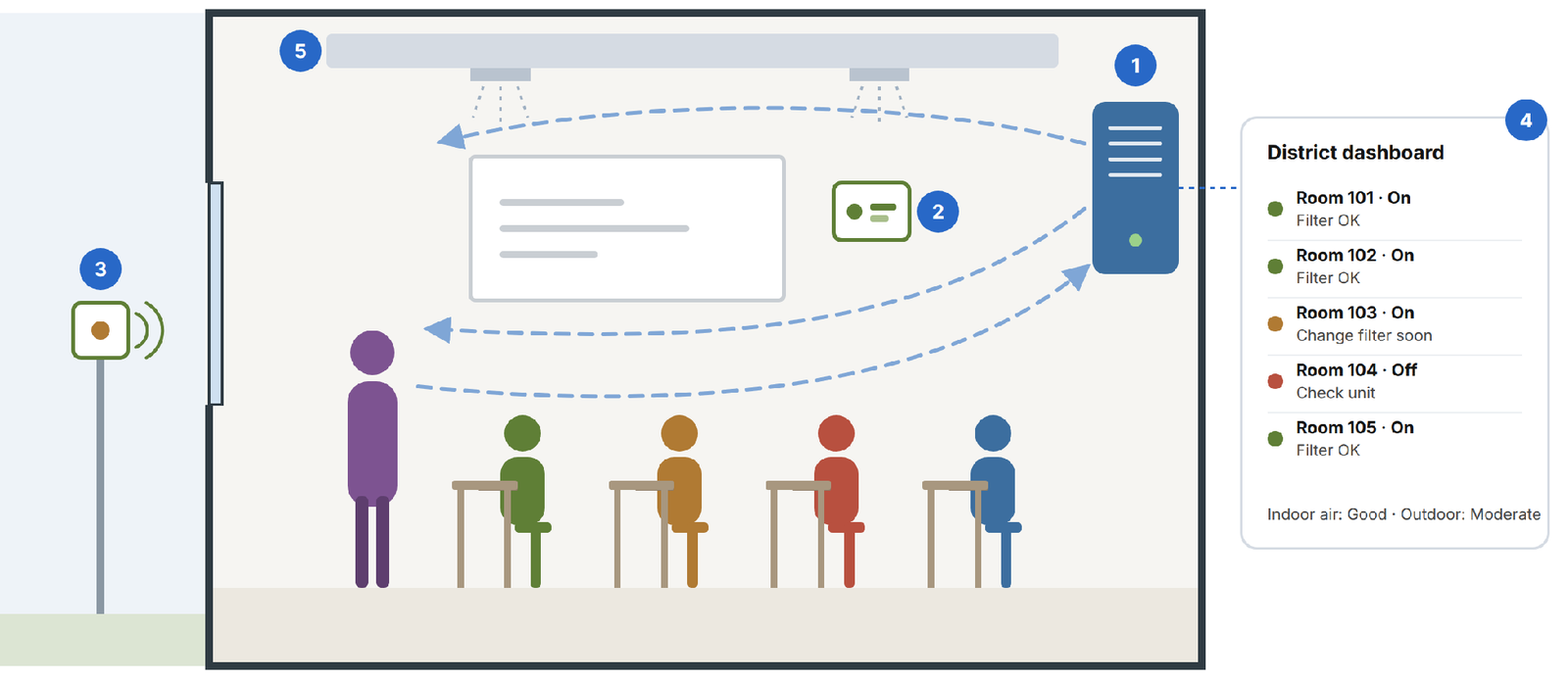
In practice
The field
Its School Air Quality Fellowship helps 50 district staff a year write indoor air policies. It co-developed with us the Model RFP and performance criteria for classroom air cleaners.
Co-founded by Dr. Georgia Lagoudas and Bronwyn King, Air Club builds the global movement for healthy indoor air, including a pledge launched at the United Nations in 2025.
Its Clean Air School Challenge offers schools up to $30,000 for indoor air quality work, in collaboration with the Center for Green Schools fellowship.
The first step is a conversation about your priorities, what is already in place, and whether the fit is right. Or get updates as the program takes shape.